
-Mark-Kolbe-Getty.jpg)
The Sochi 2014 Paralympic Winter Games were a stunning success, exceeding all expectations.
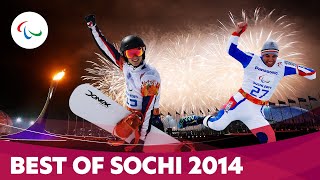
In a Games of many highlights, one of the best was the vocal crowds and packed venues that became a trademark of Sochi 2014. A record 316,200 tickets were sold, a figure that was almost 40 per cent higher than had been achieved at Vancouver 2010. The Games were also the most watched in history, attracting a cumulative TV audience of 2.1 billion people. Three National Paralympic Committees made their Paralympic Winter Games debuts.
Traditionally, Russian spectators only cheer their own athletes. But they were quickly infected by the Paralympic Spirit, supporting and celebrating the performances of every single athlete.
The biggest impact Sochi 2014 had was on the Russian government and Russian society.
In 1980 the former USSR declined the opportunity to stage the Paralympics because they said the country had nobody with an impairment. Thirty years on, and the attitude could not have been more different.
The driver behind this change was the Games.
Sochi's election as host city in 2007 led – for the first time – to Russian authorities and society paying attention to the issue of inclusion, and creating accessible environments for all.
New legislation was passed at the highest levels of Government, and the Sochi 2014 Organising Committee created a barrier-free infrastructure, ensuring that everything built for the Games was accessible for all.
According to Russia's Deputy Prime Minster Dmitry Kozak, "they showed what people from different countries and nationalities, different cultures and traditions are capable of when they are united by a single goal and an inspired dream."
Sochi became a blueprint for the rest of Russia, with 200 cities already using what was created for the Games as a guide for furthering their own accessibility, permanently improving and enriching the lives of millions of Russians.
COMPETING NATIONS AND ATHLETES
A total of 541 Para athletes from 45 countries competed at the Sochi 2014 Games with Brazil, Turkey and Uzbekistan making their Paralympic Winter Games debut.
With 72 Para athletes, USA had the biggest delegation followed by hosts Russia (69) and Canada (49).
USA had the biggest number of female Para athletes (20).
Top Videos
SPORTS
The Games featured 72 medal events in five sports across Sochi's coastal and mountain clusters. The coastal cluster hosted Para ice hockey and wheelchair curling, while the mountains hosted alpine skiing, Para biathlon and Para cross-country skiing events. With two medal events, Para snowboard made its Paralympic Winter Games debut as a discipline under Para alpine skiing.
Para alpine skiing featured 32 medal events which attracted 214 Para athletes from 40 countries.
There were 18 medal events in Para biathlon which involved 95 Para athletes from 16 counties, while the 20 Para cross-country skiing medal events saw 147 Para athletes from 22 countries take part.
Eight nations contested the Para ice hockey competition and 10 countries the wheelchair curling medal event.
-Mark-Kolbe-Getty.jpg)
©AI Tielemans for OIS/IOC
OUTSTANDING PERFORMANCES
With Russia dominating the overall medals table, 26 Para athletes from the host nation won more than one medal. In Para biathlon and Para cross-country skiing, Roman Petushkov led the way winning six gold medals. Compatriots Alexey Ivanov and Mikhalina Lysova won three gold and three silver medals each.
Just as Canada's Lauren Woolstencroft had done at Vancouver 2010, German sit skier Anna Schaffelhuber won five from five in Para alpine skiing. France's Marie Bochet won four gold medals.
The first gold medals in Para snowboard went to the Netherlands' Bibian Mentel-Spee in the women's event, while Evan Strong led a podium sweep for the USA in the men's medal event.
Results
Russia topped the medals table by a significant margin. The host nation medalled in all sports and finished the Games with 30 golds, 28 silvers and 22 bronze medals. Germany and Canada finished second and third respectively.
Nineteen of the 45 competing countries won at least one medal with Great Britain winning its first ever Paralympic Winter Games gold medal.
The hosts topped the medals table in Para alpine skiing, Para biathlon and Para cross-country skiing.
Gold in Para ice hockey went to USA who defeated Russia in the final. Canada took bronze.
In wheelchair curling gold was won by Canada with silver and bronze going to Russia and Great Britain respectively.


Paralympic Torch Relay
The Paralympic Torch Relay passed through all eight of Russia's Federal Districts. From 26 February to 7 March 2014, more than 1,000 torchbearers carried the Paralympic Torch through at least 50 Russian regions.
The inaugural Heritage Flame was lit at Stoke Mandeville Stadium in Aylesbury, Great Britain as part of the celebrations, which was the first time there has been an international leg of the Paralympic Torch Relay. The ceremony celebrated the history of the Paralympic Games and Stoke Mandeville's position as the birthplace of the Paralympic Movement.
Every day, the Paralympic Flame was lit simultaneously in several Russian cities, so that at the end of the relay, thanks to the Paralympic Flame Unification Ceremony, it reached the Opening Ceremony of the Paralympic Winter Games.
OPENING CEREMONY
The stunning Sochi 2014 Paralympics Opening Ceremony at Fisht Stadium included a volunteer cast of more than 2,500 people from the Krasnodar region of Russia taking centre stage. Two-time Paralympic champion swimmer Olesya Vladykina and six-time Paralympic champion cross-country skier Sergey Shilov lit the Paralympic cauldron.
With a theme of "Breaking the Ice," the Opening Ceremony evoked the spirit of Russia and the importance of breaking down barriers and stereotypes faced by people around the world every day.
IPC Honorary Board member and opera singer Maria Guleghina performed on a giant icebreaker ship as it passed through the stadium, signifying breaking down barriers and tracing new paths for mankind.
-Ian-Walton-Getty.jpg)
©AI Tielemans for OIS/IOC
CLOSING CEREMONY
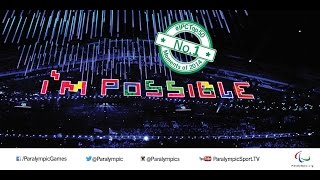
Through the theme of "Reaching the Impossible," the Sochi 2014 Paralympics Closing Ceremony illuminated how dreams can be achieved through strength and passion to change the perception of "impossible" to "I'm possible."
Abstract artwork was brought to life by 462 performers dressed in bright colours who formed geometric shapes to display different images, including illustrations of various winter sports.
A man in a wheelchair then appeared on the scene, faced with the challenge of climbing a 15 metre rope. When he accepted the challenge and reached the top of the rope, he became a flying apostrophe between the letters 'I' and 'M' in 'IMPOSSIBLE' to create 'I'M POSSIBLE,' with a spectacular fireworks display celebration the transformation.
The 8,000 Sochi 2014 Paralympic volunteers were recognised as heroes of the Games, and performers in red, blue and green transformed the Paralympic Agitos logo into a giant heart, embracing 51 volunteers at its centre.
Also during the Ceremony, the Whang Youn Dai Award was presented to Australian alpine skier Toby Kane and Dutch snowboarder Bibian Mentel-Spee for not only achieving sporting excellence, but also for exemplifying the spirit of the Games by inspiring and exciting the world.
An enchanting cast filled the stage for the finale, putting on a huge dance sequence that included four international voices – Jose Carreras –Nafset Chenib, Diana Gurtskaya and Valeriy Kozlovsky – and ended with a large fireworks display across the entire Olympic Park.
-Dennis-Grombkowski-Getty.jpg)
©AI Tielemans for OIS/IOC
ATTENDANCE AND COVERAGE
Sochi 2014 was record-breaking in terms of ticket sales and media coverage for a Paralympic Winter Games, with 316,200 tickets sold, which was 86,200 more than Vancouver 2010.
The Games were the most watched in history. They were broadcast to a cumulative global TV audience of nearly 2.1 billion people on 125 channels in more than 55 countries and territories, with broadcasters showing more hours of coverage than previous editions of the Games.
In the host country of the Games, broadcasters VGTRK, RBC TV and ANO Sports Broadcasting showed 180 hours of coverage. NBC showcased Paralympic coverage for the first time in the USA, while Channel 4 (Great Britain), EBU (Europe) and NHK (Japan) also had unprecedented coverage for a Winter Games.
The Games were also shown on Attitude Pictures (New Zealand), KBS (South Korea), CCTV (China) and America Movil in the Americas.
Through working with the National Paralympic Committees of Australia, Brazil, Canada and South Africa, the Winter Games were also shown on ABC, Globo's Sportv, and CBC/Radio Canada and SuperSport, respectively.
The Samsung Paralympic Bloggers project was carried out for the second time by the IPC and Samsung, with 30 of the world's leading winter athletes providing over 100 behind-the-scenes video blogs that received more than 50,000 views.
The IPC's online channels experienced tremendous growth, as www.Paralympic.org, showed more than 300 hours of live coverage and tripled its average monthly traffic. On its YouTube channel, the IPC recorded nearly 2.5 million views, and its Facebook and Twitter pages both increased their following by about 13 per cent.
During Sochi 2014, there were over 73,000 tweets using the #Paralympics hashtag and 92,000 mentioning the word "Paralympics."
-Ronald-Martinez-Getty.jpg)
©AI Tielemans for OIS/IOC

Medals
The medals of the Sochi 2014 Paralympic Winter Games are adorned with overlapping diamond shapes in a patchwork quilt design of varying Russian cultural and ethnic patterns. The front face of the medal features the Paralympic logo next to the solid gold and translucent pattern. The medals showcase nature-based designs, spanning the country with the sun beaming across snow-covered mountains and onto the black sand beaches.
They symbolise the integrity, strength and spirit of the Paralympians who competed in the Games. The medals are the heaviest medals in the history of the Paralympic Games.

Mascot
The Sochi 2014 Paralympic Winter Games featured two complementary mascots. One, a snowflake girl, and the other, a ray of light boy. Both were aliens who crash landed on earth from their respective planets.
They quickly adapted to their environment, learning Para biathlon and Para cross-country skiing and eventually inventing Para ice hockey and wheelchair curling. They bonded over sport, learning that their differences do not matter.
Ray of Light and Snowflake were carefully selected through a design competition. They were the winning mascots among 24,048 submissions.

Torch
The bright blue Sochi 2014 Paralympic Winter Games torch combines design concepts of modern technology and a traditional Russian fairytale. The torch is meant to mirror the feather of the phoenix. The phoenix itself is a bird that is reborn from ashes once burned, a story traditionally told in Russia. The torch represents this principle or rising from ashes alongside the joy and good fortune that the feather is rumored to give
It was designed by Russians Vladimir Pirozhkov and Andrei Vodyanik. The creators especially engineered the torch so that it would endure intense Russian wind and snow. The Sochi 2014 torch relay is the grandest torch relay in Paralympic history, covering every single one of the 50 regions of Russia.
SOCHI 2014 NEWS
View more
Top moments of 2025: Summer sports
With 2025 coming to a close, now is the perfect time to relive some of the best moments from the year.

World Para Athletics expresses condolences on the passing of Nicholas Hum
The 32-year-old athlete was one of Australia’s most accomplished long jumpers over the past decade, with the bronze medal at Tokyo 2020 Paralympic Games being the highlight of his career

Araujo earns third straight title; Smith leads women’s field in 2025 World Series
Athletes across seven categories conclude the season after eight stops worldwide as final ranking of athletes who topped their categories announced

Para Swimming World Series: Know all winners
First awarded in 2017, here are the winners of all editions of the World Series in the Female and Male Overall, High-Support Needs and Juniors Athletes categories, as well as the best National Paralympic Committee (NPC) of each year

Dani Aravich's mission beyond the medals at Milano Cortina 2026
What are Danielle Aravich's big goals at the Milano Cortina 2026 Paralympic Winter Games? Aravich joined the International Paralympic Committee on a TikTok Live to discuss everything from training tips, to goals beyond the medals and fan experience

Sardinia to host fourth Open Water Cup under three-year commitment
The competition returns in September 2026, launching a multi-year framework to further develop Para Swimming’s open water pathway