
 Facebook
 Instagram
 Twitter
 Youtube
 TikTok
 Newsletter Subscribe
HISTORY OF PARA ALPINE SKIING
Para alpine skiing is practised worldwide and features six disciplines: downhill, slalom, giant slalom, super-G, super combined, and team events. Athletes combine speed and agility while racing down slopes at speeds of around 100km/h.
The sport was developed following the end of the Second World War, when injured ex-servicemen returned to the sport they loved. In 1948, the first Para alpine skiing courses were offered.
Competition accommodates male and female athletes with a physical impairment such as spinal injury, cerebral palsy, amputation, les autres conditions and blindness/vision impairment.
Athletes compete in three categories based on their functional ability, and a results calculation system allows athletes with different impairments to compete against each other.
Skiers with blindness/vision impairment are guided through the course by sighted guides using signals to indicate the course to follow. Some athletes use equipment that is adapted to their needs including single ski, sit-ski or orthopaedic aids.
International Ski and Snowboard Federation (FIS) is the global governing body of Para alpine skiing.
Five events are on the Paralympic programme: downhill, super-G, super combined, giant slalom, and slalom.
DOWNHILL
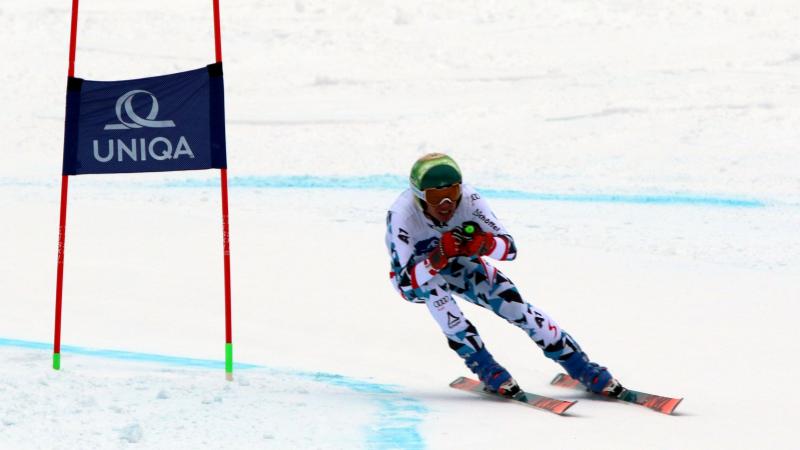
Each athlete competes one run down the course with their finish time determining the final order based on ascending time. Athletes ski down a long, steep course and must pass through a relatively few number of gates.
If an athlete misses a gate they are disqualified.
SLALOM
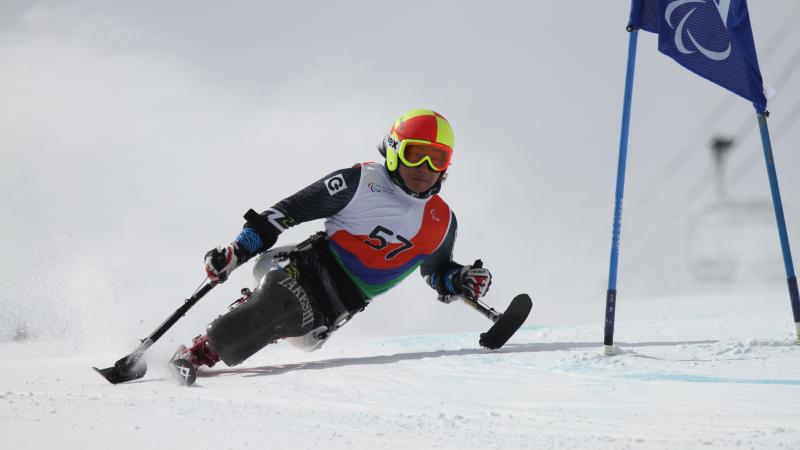
Each athlete competes two runs on the same day on different courses.
Times from the two runs are added together to determine the final order based on ascending total time. It is a technical event over a shorter course than other events but with a high number of gates that the athlete must negotiate.
If an athlete misses a gate they are disqualified.
GIANT SLALOM
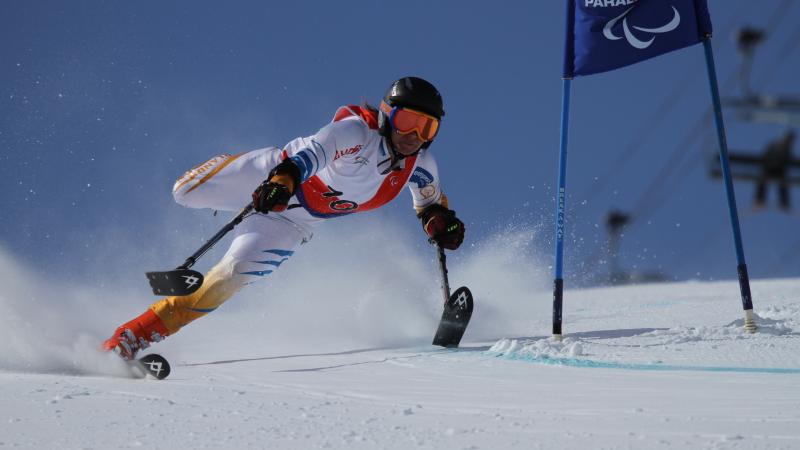
Each athlete completes two runs on the same day on different courses.
Times from the two runs are added together to determine the final order based on ascending total time. It is a technical event with a longer course and fewer gates than the slalom. The number of gates is determined by the vertical drop of the course.
If an athlete misses a gate they are disqualified.
SUPER-G
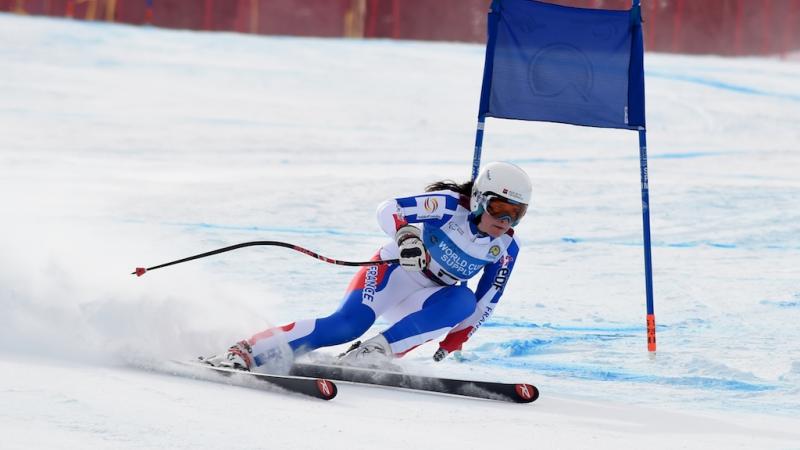
A speed event where each athlete completes one run down the course with their finish time determining the final order based on ascending time.
The course is generally shorter than downhill but longer than slalom and giant slalom.
SUPER COMBINED
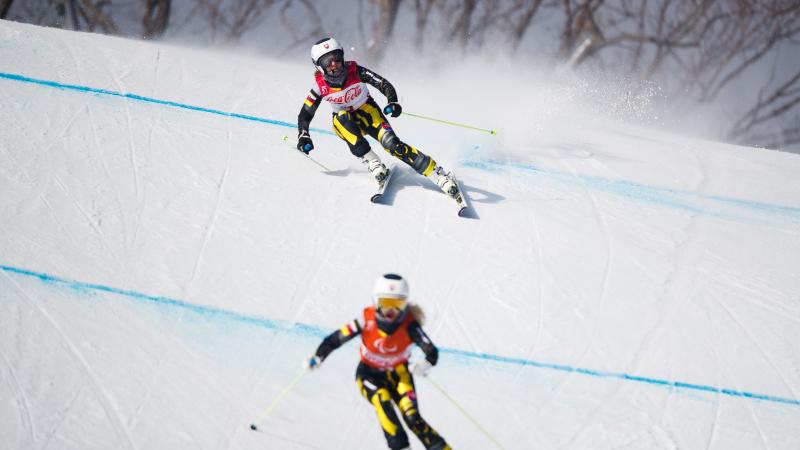
A combined competition which represents the final result of two disciplines - usually one of either a downhill or super-G and a single run of slalom.
Each athlete competes two runs on the same day on different courses. Times from the two runs are added together to determine the final order based on ascending total time.
COMPETITION HISTORY
The first documented Championships for skiers with an impairment were held in Badgastein, Austria, in 1948 with 17 athletes taking part. Since 1950, events have been held around the world. The introduction of sit-ski allowed people in wheelchairs (paraplegics and double above-the-knee amputees) to begin to ski and race.
The first Paralympic Winter Games took place in Örnsköldsvik in Sweden in 1976 and featured two alpine disciplines - slalom and giant slalom.
Downhill was added to the Paralympic programme in 1984 in Innsbruck, Austria, and super-G was added in 1994 at Lillehammer, Norway.
Sit-skiing was introduced as a demonstration sport at the Innsbruck 1984 Paralympics and became a medal event at the Nagano 1998 Games.
GROWTH OF PARA ALPINE SKIING AT THE PARALYMPIC WINTER GAMES
| Year | Countries | Medal Events | Male | Female | Total | TOP 3 COUNTRIES |
|---|---|---|---|---|---|---|
| 1976 | 12 | 28 | 64 | 14 | 78 | 1. SUI 2. GER 3. AUT |
| 1980 | 15 | 22 | 98 | 34 | 132 | 1. AUT 2. SUI 3. USA |
| 1984 | 21 | 56 | 150 | 44 | 194 | 1. AUT 2. USA 3. GER |
| 1988 | 21 | 43 | 167 | 36 | 203 | 1. AUT 2. GER 3. USA |
| 1992 | 23 | 48 | 165 | 47 | 212 | 1. USA 2. GER 3. AUT |
| 1994 | 24 | 66 | 175 | 45 | 220 | 1. USA 2. GER 3. FRA |
| 1998 | 26 | 54 | 179 | 50 | 229 | 1. USA 2. ESP 3. SUI |
| 2002 | 30 | 53 | 145 | 49 | 194 | 1. USA 2. AUT 3. GER |
| 2006 | 30 | 24 | 146 | 44 | 190 | 1. GER 2. FRA 3. USA |
| 2010 | 37 | 30 | 135 | 56 | 191 | 1. GER 2. CAN 3. SVK |
| 2014 | 40 | 32 | 158 | 56 | 214 | 1. RUS 2. GER 3. FRA |
| 2018 | 33 | 30 | 101 | 40 | 141 | 1. SVK 2. FRA 3. GER |
| 2022 | 37 | 30 | 115 | 52 | 167 | 1. AUT 2. NOR 3. CHN |
ALL-TIME PARALYMPIC ALPINE SKIING MEDALS TABLE
| RANK | COUNTRY | GOLD | SILVER | BRONZE | TOTAL |
|---|---|---|---|---|---|
| 1 | Austria | 94 | 93 | 93 | 280 |
| 2 | USA | 91 | 97 | 70 | 258 |
| 3 | Germany | 58 | 41 | 38 | 137 |
| 4 | Switzerland | 45 | 39 | 25 | 109 |
| 5 | France | 42 | 42 | 36 | 120 |
TOP 5 MALE PARALYMPIC MEDALLISTS
| RANK | ATHLETE | YEARS COMPETING | GOLD | SILVER | BRONZE | TOTAL |
|---|---|---|---|---|---|---|
| 1 | Gerd Schoenfelder (GER) | 1992-2010 | 16 | 4 | 2 | 22 |
| 2 | Rolf Heinzmann (SUI) | 1980-2002 | 12 | 2 | 0 | 14 |
| 3 | Martin Braxenthaler (GER) | 1998-2010 | 10 | 1 | 1 | 12 |
| 4 | Hans Burn (SUI) | 1988-2002 | 6 | 5 | 3 | 14 |
| 5 | Greg Mannino (USA) | 1988-1998 | 6 | 4 | 2 | 12 |
TOP 5 FEMALE PARALYMPIC MEDALLISTS
| RANK | ATHLETE | YEARS COMPETING | GOLD | SILVER | BRONZE | TOTAL |
|---|---|---|---|---|---|---|
| 1 | Reinhild Moeller (GER) | 1980-2006 | 16 | 2 | 1 | 19 |
| 2 | Sarah Will (USA) | 1992-2002 | 12 | 1 | 0 | 13 |
| 3 | Henrieta Farkasova (SVK) | 2010-present | 11 | 2 | 1 | 14 |
| 4 | Lauren Woolstencroft (CAN) | 2002-2010 | 8 | 1 | 1 | 10 |
| 5 | Marie Bochet (FRA) | 2014-present | 8 | 1 | 0 | 9 |