 Facebook
 Instagram
 Twitter
 Youtube
 TikTok
 Newsletter Subscribe
BEIJING 2008 PARALYMPIC GAMES
The Beijing 2008 Games drew global attention to the Paralympics for the first time and highlighted how the event could act as a catalyst to social inclusion.

A total of 3,951 Para athletes (2,568 men and 1,383 women) representing 146 countries took part in the Games, contesting 472 medal events across 20 sports. Five NPCs took part for the first time.
The Games were record-breaking in many areas setting the benchmark for all future Organising Committees. Hosts China dominated the medals table and overall Para athletes broke 279 world and 339 Paralympic records.
Winning the right to host the Games acted as a trigger for the Chinese government to improve the lives of persons with disabilities and protect their rights as equal members of society.
To meet the requirements of the Paralympics, new legislation on the building of accessible facilities was passed. In the seven years leading up to the Games, RMB 1billion – equivalent to EUR 124million and the sum of the last 20 years’ investment – was spent on making 14,000 facilities, including roads, transport hubs and public buildings, accessible throughout China.
More than RMB 67million was spent making 60 of the country’s most popular tourist destinations accessible.
On 1 July 2008, the revised Law of the People’s Republic of China on the Protection of People with a Disability came into force, having been adopted by the National People’s Congress Standing Committee months earlier. The law provided that state and society should take measures to improve accessible facilities and promote accessible information, in order to enable equal participation in social life for people with an impairment.
China was also among the first signatories of the UN Convention on the Rights of Persons with Disabilities – the first international human rights treaty – that came into effect on 3 May 2008.
Thanks to the Games, persons with disabilities in China now enjoy a better social status; more public attention, respect, improvement of social security, easier access to employment, better education opportunities, and much more.
SPORTS
With the addition of rowing to the sport programme for the first time, a total of 20 sports took place in China. All but sailing and equestrian events were held in Beijing.
The full programme included; archery, Para athletics, boccia, cycling, equestrian, football 5-a-side, football 7-a-side, goalball, judo, Para powerlifting, rowing, sailing, shooting Para sport, Para swimming, table tennis, sitting volleyball, wheelchair basketball, wheelchair fencing, wheelchair rugby and wheelchair tennis.
TORCH RELAY
The 10 day long Paralympic Torch Relay involved 850 torch bearers in the two-route run. The “Ancient China” route covered the historic cities of Xi’an, Hohhot, Changsha, Nanjing and Luoyang. The “Modern China” route took in Shenzhen, Wuhan, Shanghai, Qingdao and Dalian.
The Paralympic Torch Relay Launch Ceremony took place at the Temple of Heaven and was attended by Chinese Premier Wen Jiabao.
OPENING CEREMONY
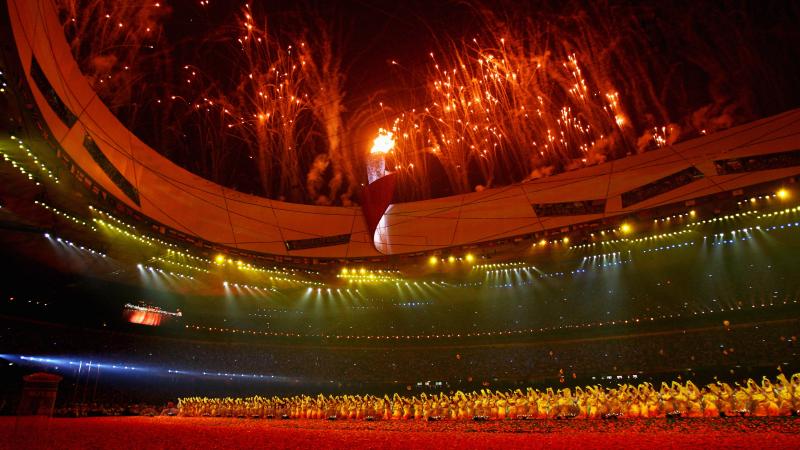
The 90,000 seat Bird’s Nest Stadium staged the spectacular Beijing 2008 Paralympics Opening Ceremony which involved the contributions of 4,813 performers.
Three-time Paralympic champion in the men’s high jump and Paralympian Ambassador Hou Bin lit the Paralympic torch in sensational style, climbing a rope to the roof of the Bird’s Nest using nothing but the strength in his arms.
The Games were then officially opened by Hu Jintao, President of the People’s Republic of China.
MEDALS
In a repeat of the Athens 2004 Paralympic Games, China and Great Britain held the top two positions in the medals table. The host nation took home 89 golds, whilst Great Britain, who staged the next Paralympic Games in 2012, took home 42 gold medals.
OUTSTANDING PERFORMANCES
In the Birds Nest stadium, Canada’s T54 wheelchair racer Chantal Petitclerc was unbeatable taking five gold medals in all distances from 100m through to 1,500m.
South African Oscar Pistorius claimed three golds in the 100m, 200m and 400m T44 races, setting a new world record of 47.49 seconds in the 400m. Ireland’s Jason Smyth was equally impressive setting new world records on his way to gold in the 100m and 200m T13 races.
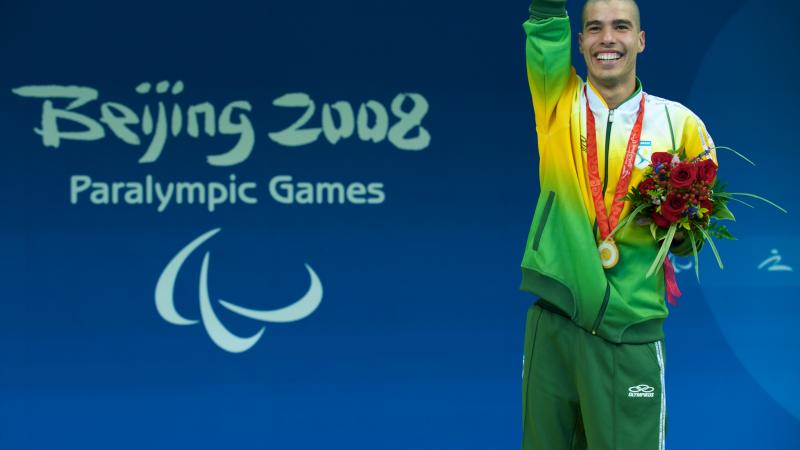
Brazil’s Daniel Dias was the man to beat in the ‘Water Cube’ taking home a total of nine swimming medals including four golds, four silvers and one bronze. South Africa’s Natalie du Toit was equally as impressive winning five gold medals out five events. At the closing ceremony du Toit was awarded the Whang Youn Dai Achievement Award, in recognition of her exemplary role in practicing the Paralympic motto “Spirit in Motion”.
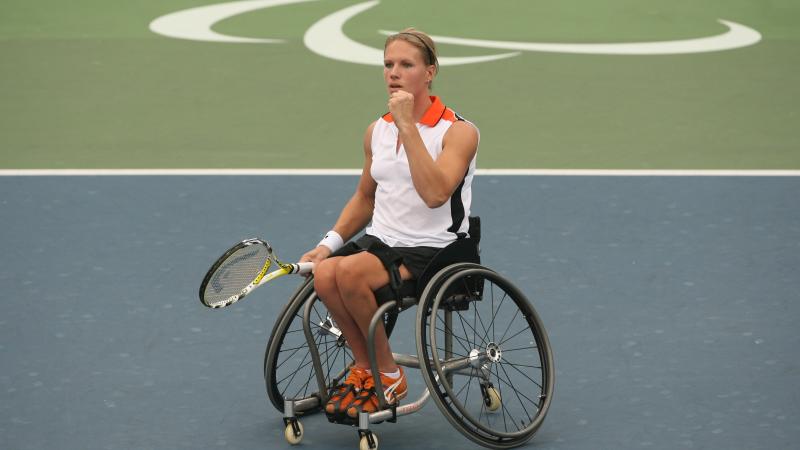
Dutch wheelchair tennis player Esther Vergeer collected her third consecutive Paralympic Games gold medal with victory in the women’s singles, whist Polish table tennis player Natalie Partyka competed in both the Olympic and Paralympic Games, taking gold in the women’s individual TT10 final in the latter event.
Australia’s 19-year-old rugby player Ryley Batt scored a record 23 points as his country took home silver.
ATTENDANCE AND COVERAGE
The Games saw 1.82 million tickets sold and a further 1.62 million tickets provided to children, education and community groups. The Opening and Closing Ceremonies were sold out, as were all swimming events and most athletics sessions.
With 64 rights holders covering 80 countries from all five continents, the Beijing Games had more TV coverage than ever before. A cumulated audience of 3.8 billion watched the Games and the total broadcasting time increased by 200 per cent compared to the Athens 2004 Paralympic Games.
China’s CCTV and BTV broadcast 22 hours of coverage daily on different channels.
The Games were also broadcast on the IPC’s online TV channel as well as on www.youtube.com/ParalympicSportTV, a new channel launched prior to Beijing. This gave those without access to TV coverage the opportunity to watch the event on their computer screen.
CLOSING CEREMONY
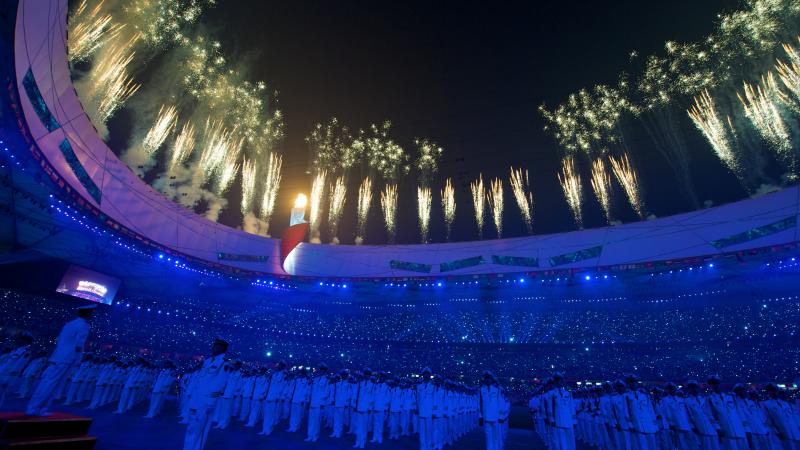
The Beijing 2008 Paralympics Closing Ceremony on 17 September took the theme ‘A Letter to the Future’ and featured about 2,000 performers.
London, the host of the 2012 Paralympic Games, staged an eight minute performance and aimed to show how sport can promote the Paralympic Movement and positively influence young people’s lives.