
Classification Code
The Classification Code is the fundamental document upon which Classification in the Paralympic Movement is based.
CLASSIFICATION CODE
BACKGROUND
Prior to the start of the 21st century, there were no agreed unifying principles to guide the establishment and development of Para sport classification systems. Classification policies and procedures were not standardised, but rather developed organically and in isolation. As a consequence, the rate at which classification systems developed, and the quality of those classification systems, varied greatly across sports.
The IPC Governing Board recognised that, to secure the future of the Paralympic Movement, a more harmonised approach to classification was required. In 2003, the IPC Governing Board approved the classification strategy, which ultimately led to the adoption of the first edition of the Classification Code in 2007. The second edition of the Classification Code was subsequently adopted in 2015. The overarching aim of both the 2007 and 2015 editions of the Classification Code was to ensure that classification was delivered to the highest possible standard across all Para sports to ensure that Paralympic stakeholders – including athletes, coaches, administrators, the public, and the media – could have confidence in the classification process and its outcomes.
2025 IPC CLASSIFICATION CODE
The 2025 Classification Code seeks to keep pace with the rapid development of the Paralympic Movement, and so builds on the first two editions of the Classification Code. It is the result of an extensive three-year review of the 2015 Classification Code, based around open consultation with the IPC Membership and feedback received from other stakeholders including the IPC Classification Committee, IPC Athletes’ Council, IPC Board of Appeal of Classification, classifiers, human rights experts, and other relevant experts.
The 2025 Code can be downloaded from the IPC Handbook page.
INTERNATIONAL STANDARDS
The 2025 Classification Code is supplemented by three International Standards that set out additional requirements and guidance on the implementation and practical application of the Code:
- International Standard for Classification Personnel and Training: Defines what an Eligible Impairment is in Para sport, thereby ensuring that Para sports are reserved for those that have an Eligible Impairment.
- International Standard for Intentional Misrepresentation: The purpose of this International Standard is to provide detailed rules and procedures for International Federations to identify, investigate, and prosecute alleged Intentional Misrepresentation by Participants under their jurisdiction.
- International Standard for Classification Data Protection: The purpose of this International Standard is to support Classification Organisations to use Classification Data consistently in accordance with the Classification Code and their legal obligations under Data Protection Laws.
The International Standards can be downloaded from the IPC Handbook page.
CLASSIFICATION CODE COMPLIANCE
Compliance with the 2025 IPC Classification Code (the Code) and International Standards is crucial in order to achieve the aim of a consistent, structured and effective approach to Classification across Para sport. This page provides details on who must be Compliant with the Code, why maintaining Compliance is so important, and what activities the IPC has undertaken on Code Compliance.
The information on this page has been updated to reflect Compliance with, and implementation of the 2025 Code.
IPC CLASSIFICATION CODE
The Code is the fundamental document upon which Classification in the Paralympic Movement is based and it is designed to support the Paralympic Movement in developing effective Classification systems. It is intended to be specific enough to achieve harmonisation in areas where standardisation is required, and general enough in other areas to permit flexibility regarding the implementation of its principles.
The Code and International Standards can be accessed as part of the IPC Handbook.
SCOPE OF THE CODE
Article 3.1 of the Code stipulates that all IPC Members and Recognised International Federations (RIFs) are bound by and must comply with the Code and International Standards. The IPC Members are:
- Stet clita kasd gubergren, no sea takimata sanctus est Lorem ipsum dolor sit amet.
- National Paralympic Committees (NPCs)
- International Organisations of Sport for the Disabled (IOSDs)
- Regional Organisations (ROs)
Additionally, Recognised International Federations (RIFs) are also bound by the Code. RIFs are not IPC Members, nor are they not part of the Paralympic Games Sport Programme, and so are not eligible to become an IPC Member as an International Federation, but still contribute to the development of the Paralympic Movement.
Furthemore, the Code details specific provisions regarding IFs and RIFs. As stated in Article 3.1.1, International Federations are only required to comply with the Classification Code and the International Standards in relation to disciplines that are on the Paralympic Games Sport Programme. Whereas RIFs, as stated in Article 3.1.2, must undertake to be bound by and to comply with the Classification Code and the International Standards in relation to at least one discipline that it administers.
IFs and RIFs are bound to the Code and International Standards for Covered Competitions. As illustrated in Article 3.2, Code Covered Competitions include:
- 3.2.1. the Paralympic Games;
- 3.2.2. World Championships;
- 3.2.3. any Competition that is part of the direct qualification pathway to participate in the Paralympic Games, as determined by the relevant International Federation;
- 3.2.4. any Competition where Observation Assessment may take place as part of a Classification process; and
- 3.2.5. any other event or Competition specified by the International Federation in its Classification rules.
IPC CLASSIFICATION CODE
COMPLIANCE MISSION
To ensure Code-Compliant Classification systems and accompanying processes are being implemented and enforced consistently and effectively across the Movement by all IPC Members.
COMPLIANCE VISION
To achieve a positive Code Compliance culture underpinned by a shared commitment to the principles of Classification. Doing so will support the IPC’s commitment to advance Classification across the Movement, thereby promoting greater understanding of Classification as well as giving Athletes and the wider public confidence in the integrity of Para sport.
A well-functioning Classification System and processes are paramount for upholding and strengthening the integrity of Para sport. Classification is unique to Para sport and it is an ever-evolving area, therefore maintaining Code Compliance and following best practice models is the optimum way for Para sports to instil confidence that their Classification system and processes are fit and proper. Moreover, maintaining Code Compliance enables fair and competitive sport decided by sporting excellence.
2025 IPC CLASSIFICATION CODE IMPLEMENTATION
As stipulated in Article 67.1 of the Code, the Code becomes effective on 1 January 2025 with the exception that, for winter sports on the Milano Cortina 2026 Paralympic Games Sport Programme, it will come into force on 1 July 2026. Each IF and RIF will be expected to work towards the implementation of the Code from 1 January 2025 forwards.
IF COMPLIANCE STRATEGY
The IPC have developed a Compliance Strategy detailing the approach in respect to implementing the 2025 Code and International Standards and running the Compliance programme.
The strategy focuses primarily on the implementation of Classification rules using a criteria-based approach (by reference to 27 distinct Compliance criteria). The purpose of this Compliance Strategy is to detail the process on how IFs report Compliance to the IPC and how the IPC monitors Code Compliance in respect of those IFs.
Included in this Strategy is the Compliance process flowchart which outlines the steps of meeting Compliance and how issues of non-Compliance will be dealt with.
Download the IPC Compliance Strategy (PDF)COMPLIANCE ACTIVITIES
The IPC has produced an IF Self-Assessment Survey as part of the Compliance programme for Code implementation. Alongside the completion of this survey, IFs and RIFs will be expected to develop a Compliance plan indicating how and when they will meet Compliance with each Compliance criteria under the Code.
Download a copy of the IF Self-Assessment Survey questions (PDF)The deadline for IFs to complete the IF Self-Assessment survey is 30 November 2025. Following their submission, the IPC will review the information and engage with each IF as deemed appropriate.
Throughout 2025, there will be opportunities for calls to discuss matters relating to Code implementation and Compliance. The IPC may also request in-person visits to monitor Code implementation.
More information can be found in the IF Compliance Strategy.
IPC RESOURCES TO SUPPORT CODE IMPLEMENTATION
- Model Classification Rules - Drafted to help IFs and RIFs to implement the IPC Code and International Standards in connection with their respective sports.
Download the Model Classification Rules (.docx Word document) - Compliance Plan Template - Designed to help IFs and RIFs develop their action plans in respect to Code Compliance criteria.
Download the Compliance Plan Template (.xlsx Excel document) - Classification Process Flowchart - Designed to visually represent the stages of the classification process along with potential outcomes.
Download the Classification Process Flowchart (.PDF) - Evaluation Session Agreement Form template - To help IFs and RIFs with obtaining athlete consent ahead of an Evaluation session.
Download the Evaluation Session Agreement Form template (.docx Word document) - Classification Privacy Notice template - To help IFs and RIFs with the notification to athletes on the collection and processing of data collected during the classification process.
Download the Classification Privacy Notice template (.docx Word document) - Second Assessment Waiver Form template - For use by athletes wishing to waive their right to a second assessment under their respective IF or RIFs classification rules.
Download the Second Assessment Waiver Form template (.docx Word document) - International Federation Protest template - For use by IFs and RIFs in notifying a National Federation of an IF Protest in respect of an athlete under their jurisdiction.
Download the International Federation Protest template (.docx Word document) - National Federation Protest Form template - For IFs and RIFs to provide for National Federations to use when submitting a Protest to the IF for an athlete under their jurisdiction.
Download the National Federation Protest Form template (.docx Word document) - Protest Panel Outcome Form template - For use by IFs and RIFs for recording the outcome of a Protest Panel.
Download Protest Panel Outcome Form template (.docx Word document) - Confidentiality and Conflict of Interest Declaration Form template - To help IFs and RIFs in maintaining confidentiality of classification information, and in the identification and management of conflicts of interest in relation to Classification Personnel.
Download the Confidentiality and Conflict of Interest Declaration Form template (.docx Word document) - Code review webpage - Containing resources such as the Summary of Changes related to each consultation phase of the review process, consultation overview, presentation material, and the case of Azibo - a fictional Athlete case study explaining the key changes between the 2015 Code and the 2025 Code.
Go to the Code review webpage
COMPLIANCE ARCHIVE
The 2022 Classification Survey was been sent to IFs, RIFs and IOSDs, with the aims of encouraging dialogue on Code Compliance, as well as gathering information on Classification. A preliminary overview of the survey results was presented to the membership during the 2023 Annual Classification Meeting.
IFs are encouraged to regularly track and use analytics as part of their Classification programmes, for example, in respect to the number of Classification opportunities within a season/cycle, and the details of Athletes assessed, protests received, and so on. This information will help inform decisions in respect to the growth and development of the IF's Classification programme.
The IPC will look to periodically request this information as part of the Compliance oversight.
In accordance with article 13.1 of the 2015 Code, all IFs and RIFs were required to have Code Compliant Classification rules by no later than 1 January 2018. In order to be Code Compliant, each set of IF Classification rules were to be reviewed and approved by the IPC. This was a considerable task on both sides. The assessments were carried out in accordance with the International Federation Compliance Review Strategy, dated January 2017. The Classification rules were assessed against twelve Compliance criteria.
Download the 2017 International Federation Compliance Review Strategy (PDF)
MODELS OF BEST PRACTICE
- Models of Best Practice: National Classification*
- Models of Best Practice: Choice of Sport Class for Multiple Impairments**
- Models of Best Practice: Sport Class Changes following First Appearance**
* Developed under the 2015 Code and subject to review.
** Developed under the 2007 Code, with provisions captured under the 2015 and 2025 Code.
CLASSIFICATION CODE REVIEW
REVIEW OF THE 2015 IPC ATHLETE CLASSIFICATION CODE
Following the Governing Board's approval for a multi-year review of the 2015 IPC Athlete Classification Code in January 2021, the IPC Extraordinary General Assembly (EGA) approved the new 2025 IPC Classification Code on 17 May 2024. This concluded a three-phase consultation process, which saw over 80 per cent of the IPC’s membership, as well as the Athlete community, engage in the process.
Press release: IPC members approve the new Classification Code at Extraordinary General Assembly
The final versions of the 2025 IPC Classification Code and three International Standards, are now available as part of the IPC Handbook.
A combined PDF containing all four documents is also available to download below:
To help explain some of the changes, a summary document, flowchart, presentation slides from additional consultation calls, and a fictional Athlete case study have been provided below:
- Summary of Changes - Final Code and International Standards
- Classification flowchart
- Code review final draft Membership calls - slide deck and Q&A (PDF)
- The Classification case of Azibo | Classification now and under the new Code (online resource)
For further information about the Code review process and details of previous phases, please see further down the page.
General enquiries
For general enquiries about the Code review, please contact codereview@paralympic.org.
CODE REVIEW PROCESS
While classification is a complex and ever-evolving area, improving the IPC Athlete Classification Code is seen as essential for the continued development of the Paralympic Movement.
The Code Drafting Team was established by the IPC Governing Board to oversee the Review. Its role is to obtain and analyse stakeholder feedback, and to determine how best to incorporate such feedback into working drafts of the new Code. It is led by an independent chair, Scott Field. The South African swimmer, who competed in the Sydney 2000 and Athens 2004 Paralympic Games, has regular dialogue and presents updates to the IPC General Assembly, Governing Board and Membership.
At this stage, it is envisaged that implementation of the new IPC Athlete Classification Code will be January 2025 for summer sports and July 2026 for winter sports. The current 2015 IPC Athlete Classification Code and accompanying International Standards remain in place and fully effective until the new Code’s implementation date.
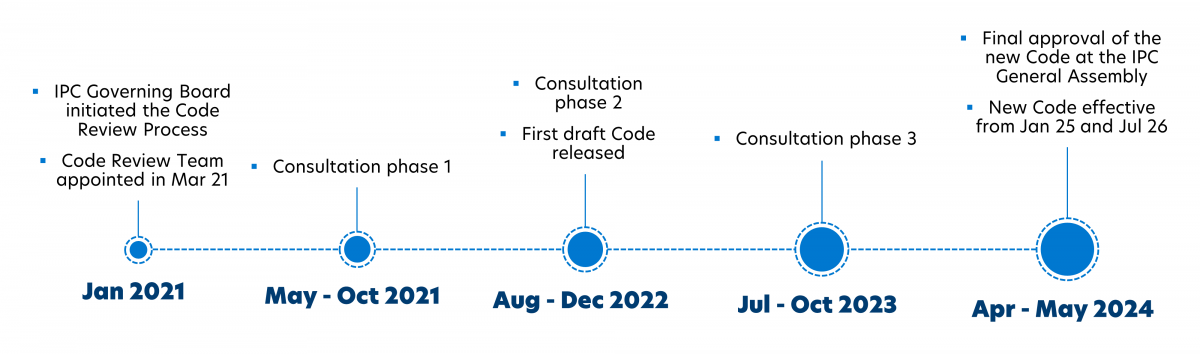
The documents below contain more detailed information on the procedure and timescales of the Code review, as well as the composition of the Code Drafting Team. These documents were last updated in March 2023 and subsequently approved by the IPC Governing Board.

Scott Field
Chair of the Code Drafting Team"It is an exciting opportunity for all to play their part in creating a better, more equitable Paralympic Movement."
CONSULTATION PHASES
Gathering feedback through consultation is at the heart of the Code review. Extensive feedback has been gathered and analysed by the Code Drafting Team through three phases of open consultation which took place between 2021-2023
- Phase 1 consultation – ended 17 September 2021
- Phase 2 consultation – ended 15 December 2022
- Phase 3 consultation - ended 31 October 2023
Regular meetings and calls were held with the IPC Membership throughout the consultation phases, along with a series of education sessions, with more planned once the final documents are published in 2024. The Code Drafting Team is also supported by several sub-groups, who lead on drafting the various supporting documents.
Feedback was encouraged from anyone with an interest in Classification across the Movement, including consultation with the IPC Athletes’ Council, IPC Medical Committee, IPC Science and Research Working Group, IPC Board of Appeal of Classification, classifiers, human rights experts, and other appropriate experts.
ARCHIVE
SUMMARY OF CHANGES
- Summary of Changes - Phase 3 (English)
- Summary of Changes - Phase 3 (French)
- Summary of Changes - Phase 3 (Spanish)
KEY DOCUMENTS
- Draft IPC Classification Code (version July 2023)
- Draft Classification flowchart (version October 2023)
- Draft International Standard for Classification Personnel and Training (version July 2023)
- Draft International Standard for Classification Data Protection (version July 2022)
- Draft International Standard for Intentional Misrepresentation (version July 2023)
- Code review phase three consultation slide deck (PDF)
FEEDBACK
An online survey was made available to anybody wishing to submit written feedback on targeted questions found in the Summary of Changes. Space to comment on the Code and International Standards was also provided.
PRESS RELEASES
SUMMARY OF CHANGES
To introduce the new drafts, a Summary of Changes explaining the rationale for key additions and amendments within the draft Code and International Standards was published:
- Summary of Changes - Phase 2 (English)
- Summary of Changes - Phase 2 (French)
- Summary of Changes - Phase 2 (Spanish)
KEY DOCUMENTS
The second draft of the Code incorporated some (but not all) of the International Standards. Therefore, the following documents were made available for feedback:
- Draft IPC Classification Code (version July 2022)
- Draft Classification flowchart (version July 2022)
- Draft International Standard for Classification Personnel and Training (version July 2022)
- Draft International Standard for Classification Data Protection (version July 2022)
FEEDBACK
As part of the second phase of the Code review, a survey exercise was conducted, resulting in the following feedback and guiding the direction of the final consultation phase:
PRESS RELEASES
KEY DOCUMENTS
The second draft of the Code incorporated some (but not all) of the International Standards. Therefore, the following documents were made available for feedback: